-
Most customers qualify for a $1,425 rebate through Focus On Energy*
*Wisconsin homes only — not available in Illinois
Choosing wall insulation · Existing homes
Three products get sold for the same job, and they are not the same job. Here is how they actually behave inside a closed wall in a Wisconsin winter — and why we only install one of them.
Erik sold injection foam for other companies for seven years before starting Cozy Walls. This is what he learned.
For an existing home with closed walls — siding on, drywall or plaster up — this is what each option gives you.
| Injection foam (what we install) | Blown-in cellulose | Spray foam | |
|---|---|---|---|
| Fills a closed wall completely | Yes — flows around wiring, pipes and blocking as a liquid, then cures in place | Partially — blown as dry fiber; bridges over obstructions and leaves voids | Only with the wall open — needs a clear cavity to spray into |
| Settles over time | No | Yes — packs down and leaves a gap at the top of the bay | No |
| Air-seals the wall | Yes — foam is the air barrier | No — slows air, doesn’t stop it | Yes |
| Holds moisture | No | Yes — recycled paper absorbs water | No |
| Drywall or plaster removal | None — installed from outside | None | Required in a finished home |
| Time in your home | 1–2 days, from outside | 1 day | Days to weeks with demolition and repair |
| Cuts outside noise | Yes — a solid, dense wall | Some | Yes |
| Fire rating | Class 1 | Treated with fire retardant | Varies by product |
| Best use | Existing homes with closed walls | Attics | New construction and open walls |
Spray foam is a great product — in an open wall. In a finished house it means demolition, and that is the whole reason injection foam exists. Cellulose is cheap to blow in and it’s what most “wall insulation” quotes are quietly selling; the problem is what it does five years later.
Here is the part most companies won’t tell you. There are two families of injection foam: resin-based foams that are mixed on site and cure like a dry meringue, and pour-in-place foams that cure as a stable structure bonded to the cavity.
Erik had the resin type injected into his own home while he was selling it for another company. A year later he lifted the house and opened the walls — and found the foam had shrunk and pulled away from the studs, leaving a gap on every side. That is why Cozy Walls exists, and why we install a pour-in-place foam that does not shrink back, rated at R-3.9 per inch with a Class 1 fire rating.
We back that with a lifetime warranty that transfers when you sell the house. Nobody warranties a product they expect to pull away from the studs.
One row of siding, a grid of small holes, foam in, siding back on. Nothing in your living space is touched.
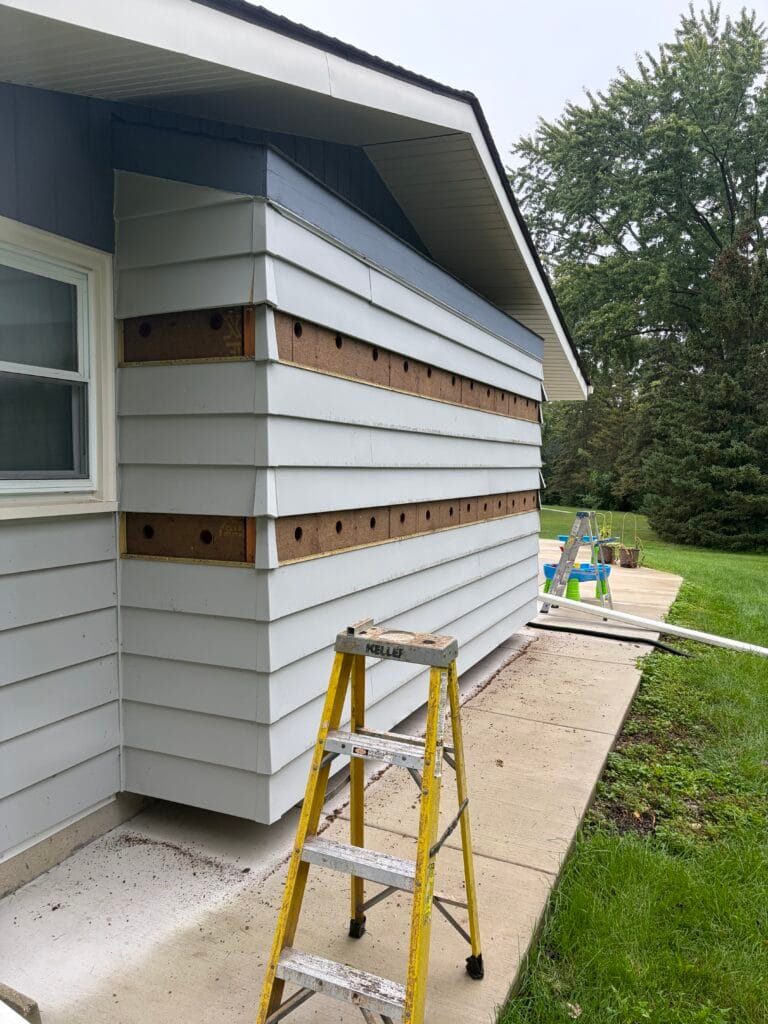
This is the whole opening. No drywall, no plaster, no dust inside.
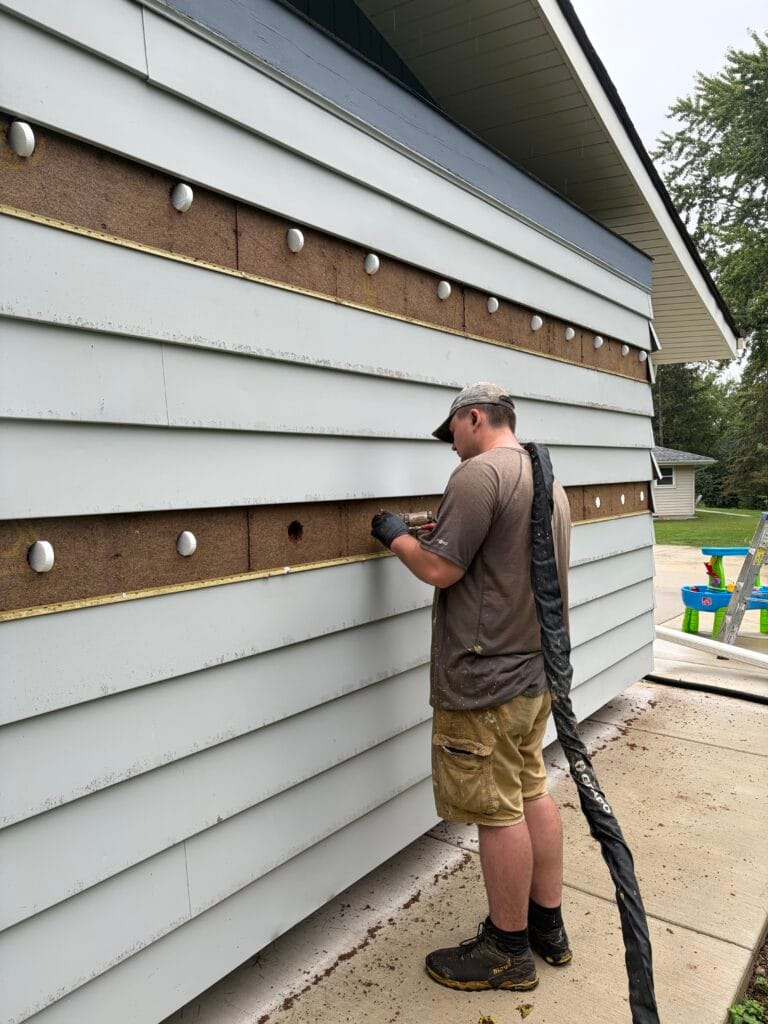
Each stud bay filled top to bottom. Plugs sealed and taped before the siding goes back.
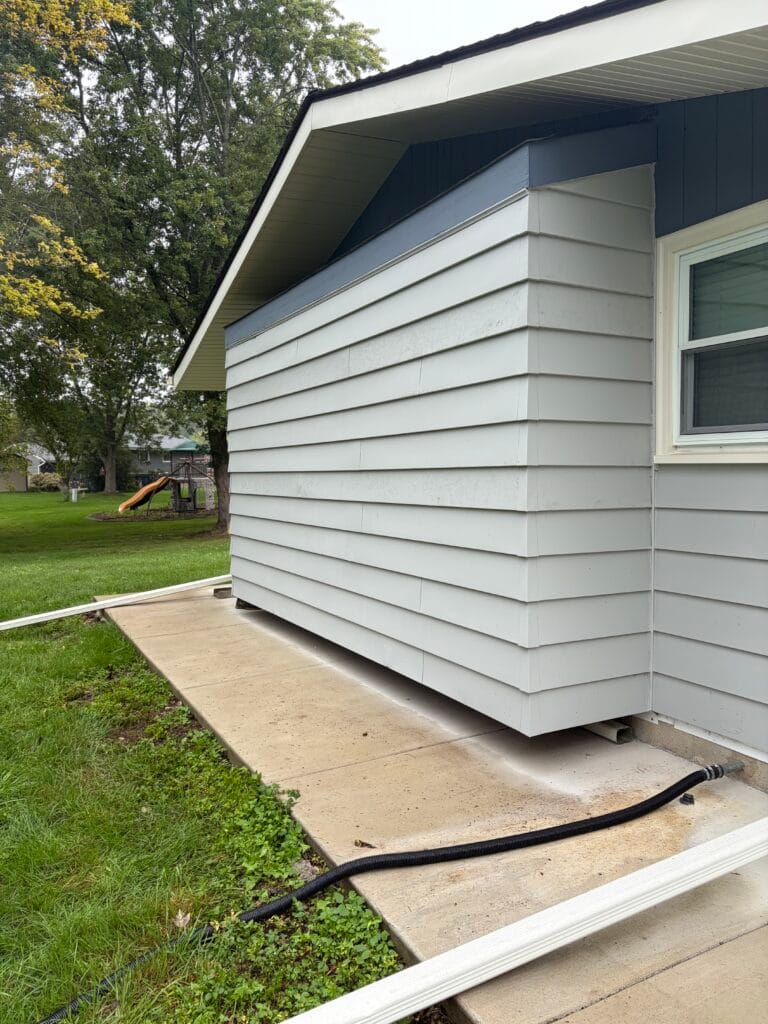
Same siding, same house. Warmer that night.
If you’re getting more than one bid — and you should — ask each installer three questions: What product, exactly? (Ask for the data sheet.) Do you test before and after? (We run a blower door and thermal scan on every whole-home job.) What is the warranty, and does it transfer?
Then bring us the lowest written quote for the same scope from a licensed, insured installer using closed-cell or injection foam. We’ll beat it by $500. Whole-home projects of $5,000 or more; in lieu of other discounts.
Free estimate. Erik, the owner, comes out himself.
No pressure. No sales script. Just Erik and real numbers.