
For rim joist insulation in a Franklin home, remove the existing fiberglass from the area being sprayed rather than applying foam over it. Closed-cell spray foam needs direct contact with a suitable, exposed surface to form an adhered air seal. For a 2026 project, the right sequence is to expose the wood, check its condition, fix moisture problems, and then install the specified foam assembly.
- Remove fiberglass before applying closed-cell spray foam to the rim joist; the wood needs to be exposed.
- Rim joist insulation should follow moisture repairs, not hide damp wood or active leaks.
- Cozy Walls provides closed-cell spray foam for exposed framing, including rim joists in its Southern Wisconsin service area.
- Ask your contractor to specify surface preparation, foam thickness, required protection, and reentry instructions.
Why this matters
Fiberglass can cover the rim joist without sealing the gaps around it. Adding spray foam over that covering leaves the contractor spraying onto loose fibers instead of the wood and joints that need attention.
Removing the fiberglass is preparation, not an optional upgrade. It also exposes stains, damaged wood, wiring, and penetrations before they disappear behind insulation. Start with this guide to preparing a basement for rim joist insulation if you are planning a 2026 project.
Can Franklin rim joists be foamed over existing fiberglass?
Not as a substitute for exposing and preparing the rim joist. The fiberglass needs to come out of the intended spray area so the installer can inspect the substrate and apply foam directly to the approved surfaces.
The rim joist closes the perimeter of the floor framing above the foundation. The work involves more than covering that board. The installer also needs access to the joints, corners, and penetrations included in the air-sealing scope.
| Approach | Best for | Benefit | Limitation |
|---|---|---|---|
| Leave fiberglass over the rim and spray its exposed face | Not recommended for direct-to-wood rim sealing | Avoids the removal step | Conceals the substrate and prevents direct foam contact with the covered wood |
| Remove fiberglass, inspect, then spray exposed framing | Homeowners replacing rim-area fiberglass with closed-cell foam | Provides access for inspection and direct application | Requires preparation, moisture checks, and any necessary repairs first |
A smooth-looking foam surface does not prove that the wood underneath was sound or that the perimeter joints were sealed. Ask what the contractor will expose and inspect before the spray equipment starts.
What if fiberglass remains somewhere else?
Fiberglass outside the intended spray area is a separate decision. For example, insulation farther along a floor cavity is not automatically part of the rim-joist replacement scope.
Have the installer identify the boundary of the work. Keep the distinction clear: fiberglass elsewhere in the assembly is not permission to spray over fiberglass covering the rim. Whether material stays, moves, or comes out depends on the assembly and the specified installation.
Closed-cell spray foam: for exposed rim framing
Closed-cell spray foam can provide insulation and air sealing when installed at the appropriate thickness on suitable surfaces. At a rim joist, its value comes from treating the exposed board and the adjoining joints as an assembly rather than stuffing material into an opening.
The advantage is direct application around accessible framing details. The limitation is that application conditions matter: substrate moisture, surface condition, temperature, and the foam manufacturer's instructions all affect the work.
Do not accept a generic thickness recommendation based only on a photograph. Ask the installer to identify the selected foam, the intended installed thickness, and how the finished assembly will meet the requirements that apply to your home.
Finished-wall injection foam is a different job
Injection foam for an enclosed exterior wall is not the same installation as closed-cell spray foam on an exposed basement rim. Access, application methods, and the surrounding construction differ.
Match the method to the space. A finished wall cavity calls for an assessment of an enclosed-wall insulation method. An accessible rim joist calls for inspection and a specification for the exposed framing.
If your estimate includes both exterior walls and basement rim joists, ask for separate scopes. That makes it clear which material goes where, what preparation each area needs, and what the contractor will inspect before installation.
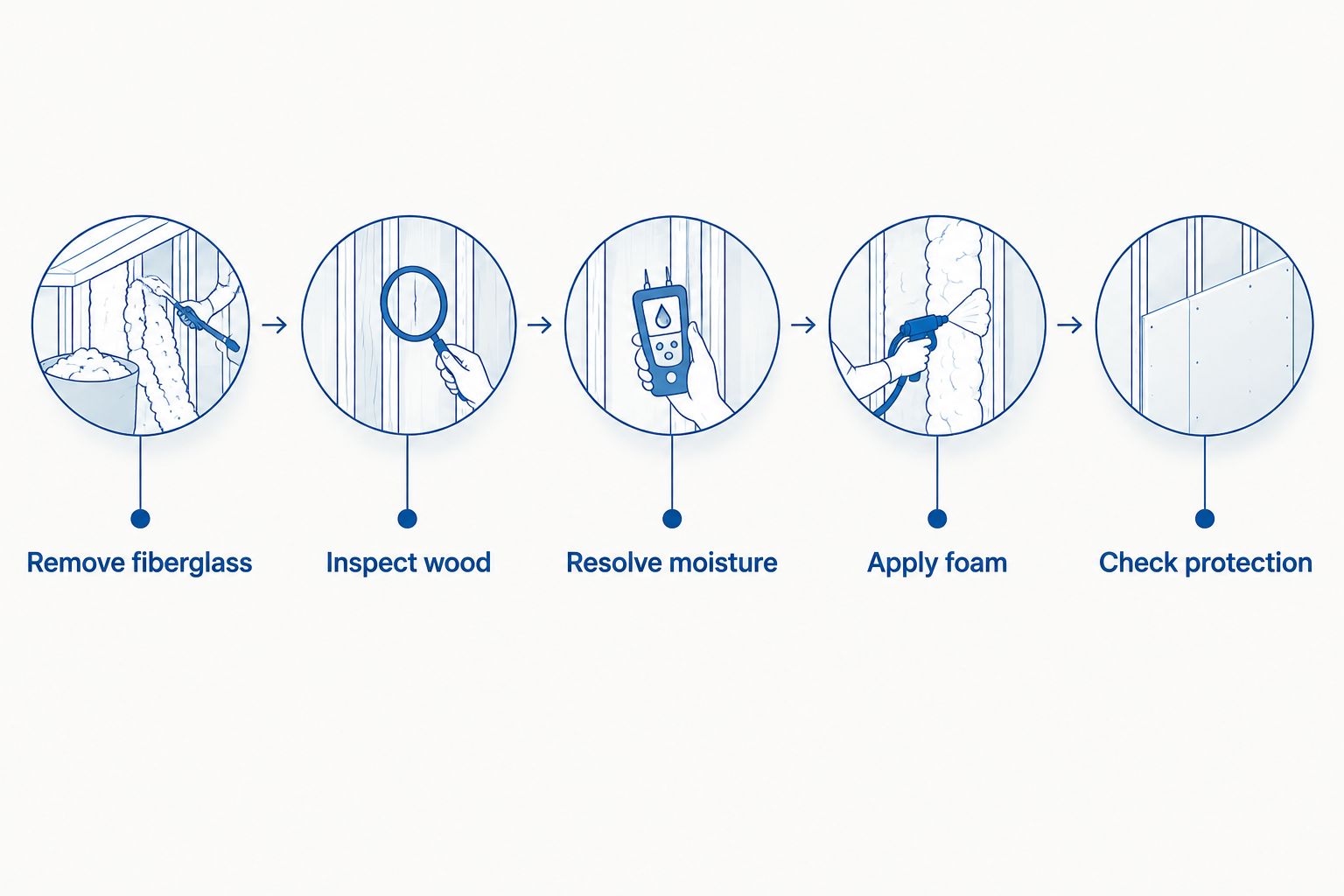
What should happen before the rim joist gets sprayed?
For a 2026 rim joist insulation project, ask the contractor to explain the preparation in this order. The sequence matters because foam should not conceal a problem that still needs repair.
Remove fiberglass
Remove the fiberglass from the intended spray area. That includes material tucked into corners where the rim board meets adjacent framing.
The purpose is access, not simply making room for another insulation layer. The installer needs to see and reach the surfaces receiving foam. Ask whether removal, containment, and disposal are included in the written scope.
Inspect wood
Inspect the exposed rim board, nearby framing, and accessible foundation connections. Staining deserves investigation; soft or deteriorated wood needs a repair decision before insulation.
Not every stain means an active leak. But a contractor should not cover an unexplained condition and call the problem solved. When structural damage is suspected, resolve the repair scope with an appropriately qualified professional.
Resolve moisture
Find the source of wetness before spraying. Rain entry, plumbing leaks, and condensation are different problems and require different corrections.
The wood also needs to meet the selected foam manufacturer's application requirements. Dry-looking wood is not a substitute for checking substrate suitability when moisture is a concern. Foam is not a repair for a leaking or decaying rim joist.
Apply foam
The installer applies the specified foam to the prepared surfaces and addresses the joints included in the scope. Pipes, wiring, and other obstructions require attention rather than a broad pass that leaves hidden gaps.
Ask how the contractor handles areas that cannot be reached. Inaccessible sections should be identified before work begins, not discovered when you ask why part of the perimeter remains untreated.
Check protection
Confirm any required ignition or thermal protection for the finished assembly. The applicable requirements depend on the product, location, and approved installation details; exposed foam is not automatically an acceptable finished condition.
Also get the manufacturer's ventilation and reentry instructions. Household members and pets should stay out of the application area according to those instructions, not an improvised rule.
Why rim joist insulation scope varies
Two Franklin basements can need different preparation even when the exposed perimeter looks similar. These conditions determine what belongs in the estimate:
- Access: Finished ceilings, shelving, stored items, and utilities can block the rim. The scope should identify what must move and who moves it.
- Existing insulation: Loosely placed fiberglass and material trapped behind other finishes require different removal work. Describe what is present rather than assuming it is all accessible.
- Wood condition: Sound wood can proceed to preparation. Suspected decay or structural damage requires a repair decision first.
- Moisture: Active leaks and unsuitable substrate conditions stop the installation sequence. Include the correction before the foam work.
- Penetrations: Pipes, cables, vents, and equipment connections create details that need inspection. Some also require clearances or specialized sealing methods.
- Finished protection: The specified foam assembly and applicable requirements determine what protection is needed after application. Ask whether that work is included.
A quote that only says “spray basement rim” leaves too much unanswered. You need the preparation, application boundaries, and finished condition in writing.
Will replacing fiberglass stop every basement draft?
No. Rim joist insulation addresses the treated perimeter, but basement air leakage can also involve windows, doors, utility penetrations, and other connections.
Describe where you feel the draft and when it occurs. A cold spot beside a basement window and moving air at the rim do not automatically have the same cause. The inspection should connect the proposed work to the actual leakage path.
Blower-door testing and thermal imaging serve different purposes. A blower-door test assesses air leakage under a pressure difference. Thermal imaging shows surface-temperature patterns under suitable conditions; it does not see through walls.
Can you spray a damp rim joist after removing fiberglass?
No. Removing fiberglass exposes the wood, but it does not make a damp substrate ready for spray foam. Correct the moisture source and confirm that the surface meets the selected product's application requirements.
Do not confuse air sealing with waterproofing. Sealing a joint does not correct exterior water entry or a plumbing leak. If the wood is damaged, repair comes before insulation.
For a Franklin homeowner, the useful question is not just whether foam can stick. It is whether the rim is sound, suitably dry, and ready to be covered.
What should your Franklin estimate include?
Cozy Walls is a fit for Southern Wisconsin homeowners seeking closed-cell spray foam for exposed rim joists. The company also provides injection foam for existing exterior walls, which belongs in a separate scope from exposed-framing work.
The owner provides the free estimate. Blower-door testing and a thermal scan are included; keep their purposes distinct. Thermal scanning applies to drywall applications and spray foam work, including rim joists. It is not a method for seeing through brick, plaster, concrete block, or cinder block.
For your 2026 estimate, ask for a written answer to each of these questions:
- Which rim areas are included, and which are inaccessible?
- Will the existing fiberglass be removed and disposed of?
- What happens if removal reveals moisture or damaged wood?
- Which foam and installed thickness are specified?
- What protection, ventilation, and reentry instructions apply?
- What will remain visible for the final walkthrough?
Review the insulation services before requesting an estimate so you can distinguish the rim-joist work from any finished-wall project. The practical limitation is access: a service description cannot settle the condition of wood hidden behind fiberglass or finished surfaces.
Request a rim joist estimate
The owner provides the free estimate. Ask about fiberglass removal, moisture checks, and the finished assembly.
FAQ
Can spray foam go directly over fiberglass at my rim joist?
Remove fiberglass from the intended rim-joist spray area first. The installer needs access to inspect the wood and apply foam directly to suitable surfaces and joints.
Do I need to remove all the fiberglass from my basement?
Not necessarily; the fiberglass covering the intended spray area needs removal. Material elsewhere in the floor assembly requires a separate decision based on the installation scope.
Is closed-cell spray foam the same as injection foam?
No. Closed-cell spray foam is applied to exposed framing, while finished-wall injection foam uses a different installation method for enclosed wall cavities.
What if the wood behind my fiberglass is wet?
Correct the moisture source before applying foam. The exposed wood must meet the selected foam manufacturer’s substrate requirements, and damaged framing needs a repair decision first.
Can a thermal scan see through my basement wall?
No. Thermal imaging shows surface-temperature patterns under suitable conditions; it does not see through walls. Blower-door testing is a separate method for assessing air leakage.
What should I ask Cozy Walls before a 2026 rim joist project?
Ask Cozy Walls to specify fiberglass removal, substrate inspection, foam thickness, required protection, and reentry instructions. Also ask which areas are inaccessible and how unexpected moisture or damage will be handled.
One last thing
Ask to see the rim after the fiberglass comes out and before foam goes in. That is the useful inspection point: the wood, joints, stains, and penetrations are still visible.
Judge the preparation before judging the finished foam. A neat surface cannot tell you whether a hidden leak was corrected. Put that inspection point in the scope before work starts.