
A wall insulation estimate near Watertown should identify the walls being insulated, the existing conditions, the foam type, the installation access, and the full written scope. It should also explain testing, cleanup, exclusions, and any rebate conditions before you approve the work. When you search for wall insulation near me, compare what each contractor will actually do—not just the total at the bottom.
- A wall insulation near me search should lead to a written scope, not just a total.
- Getcozywalls offers injection foam for existing walls and closed-cell spray foam for exposed framing.
- Brick-home injection foam installation takes 2–3 days, depending on home size.
- Keep blower-door testing separate from thermal scanning; neither is a see-through-wall inspection.
What should a wall insulation estimate near Watertown include?
Your 2026 estimate should connect the problem you want fixed with a specific installation plan. A cold bedroom, an uncomfortable garage, and drafts near the basement ceiling do not automatically call for the same work.
Start with these requirements:
- Named work areas. Identify which exterior walls, garage surfaces, crawl-space areas, or rim joists are included. Ask the contractor to identify excluded areas just as clearly.
- Existing conditions. Record what the contractor knows about the wall assembly and existing insulation. Separate confirmed conditions from anything that still needs inspection.
- Material and method. Specify injection foam for suitable existing wall cavities or closed-cell spray foam for exposed framing. A proposal that only says foam leaves too much unanswered.
- Access and repairs. Explain where installation access is needed, how openings will be closed, and who handles any finish work.
- Testing and verification. State which tests are included, what each test measures, and whether the scope includes checks after installation.
- Terms and exclusions. List cleanup, homeowner preparation, scheduling, payment terms, and rebate conditions in writing.
A quote becomes useful when you can point to a room or wall and know whether it is covered. Do not approve an estimate that leaves the work area undefined.
Why this matters
A search result can put contractors next to each other without making their proposals comparable. One estimate might cover existing exterior walls. Another might include a garage or rim joists. Those are different scopes, even when both proposals use the word insulation.
Getcozywalls provides existing-wall injection foam and closed-cell spray foam for exposed framing, with service extending to Watertown. The owner provides the free estimate. Use that visit to connect the uncomfortable areas in your home with the work being proposed.
For your 2026 project, the useful question is not simply whether a contractor installs foam. It is whether the proposed material and access method match your house. That distinction belongs in the estimate, before scheduling or signing.
Finished walls and exposed framing need different estimates
Injection foam and closed-cell spray foam are not interchangeable descriptions. Ask for the method by name and have the contractor explain why it fits the area being treated.
| Method | Best for | What the estimate should explain | Limitation to understand |
|---|---|---|---|
| Injection foam | Existing exterior wall cavities with finished surfaces | Wall areas, cavity assessment, installation access, and access-point closure | Existing wall construction affects the installation plan |
| Closed-cell spray foam | Open framing in garages, crawl spaces, and rim joists | Exposed surfaces, preparation, application scope, and protection of nearby areas | It is not the same installation method as filling a closed wall cavity |
The advantage of injection foam is that it addresses existing wall cavities without treating the job as an open-framing project. The trade-off is that the contractor must account for the construction already in place.
Closed-cell spray foam suits exposed areas where the installer can reach the intended surfaces. The trade-off is that preparation, access, and the exact surfaces being treated still need a written scope.
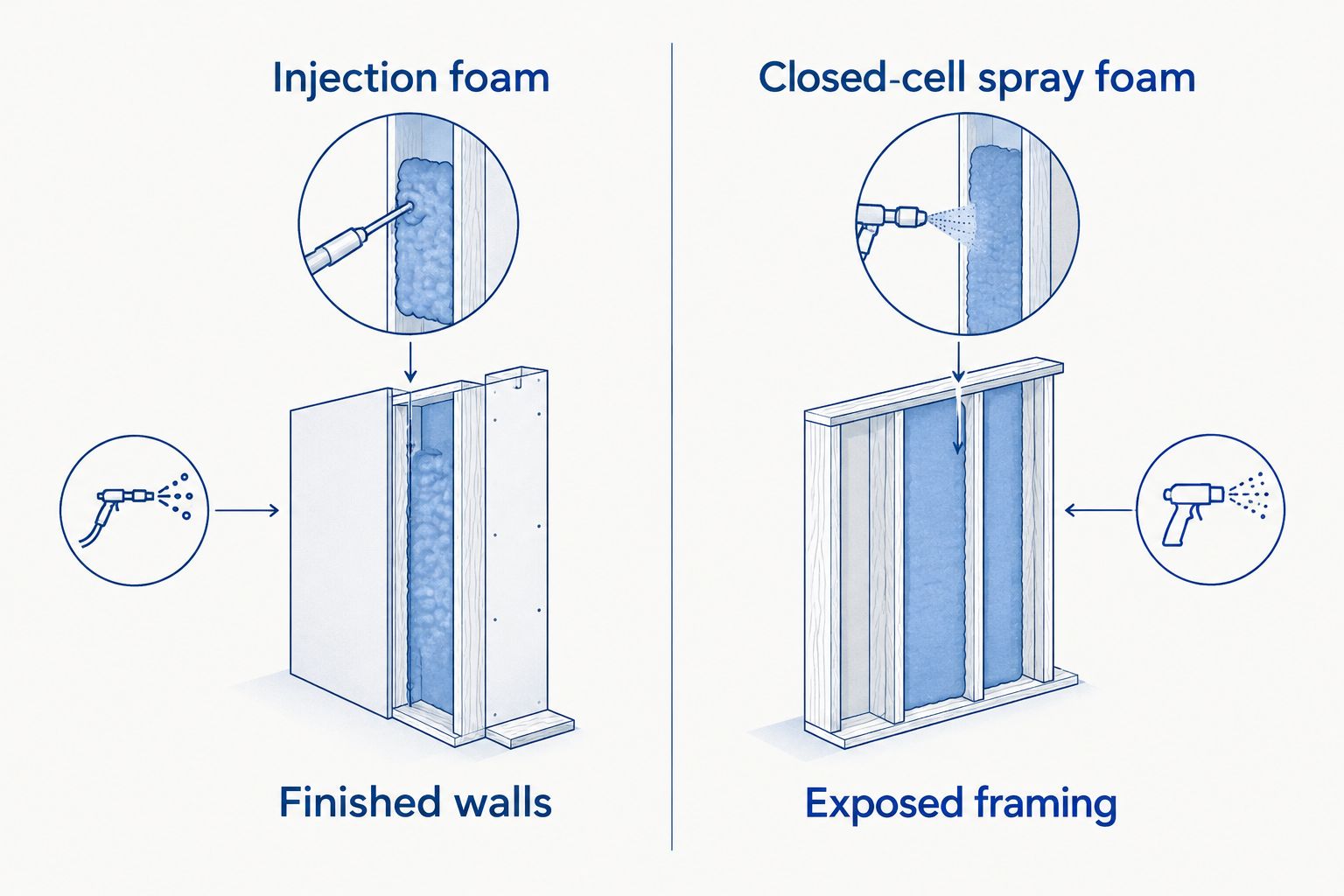
A mixed project needs separate descriptions. If you want existing exterior walls insulated and rim joists sealed, ask for each area to appear as its own scope item. You should not have to guess whether the basement work is part of the wall proposal.
Existing-wall injection foam: define the wall coverage
An existing-wall estimate should identify the exterior wall areas being treated and explain how the contractor will assess the cavities. Room names help. So do clear notes about walls that are excluded or need further inspection.
Ask what the contractor has confirmed about existing insulation. A statement that your house feels cold does not establish what is inside every cavity. Likewise, an assessment of one accessible area should not be presented as proof of every wall's condition.
Have the contractor explain the access plan in plain language. Where will the installer reach the cavities? What gets disturbed? What gets closed afterward? Who is responsible for the final appearance?
The written proposal should also explain how discoveries during installation are handled. You need a clear approval process for additional work, rather than an assumption that every condition is already known.
Brick homes: allow 2–3 days, depending on size
Brick-home injection foam installation takes 2–3 days, depending on home size. Do not apply a general siding-home timeline to a brick house. Ask the contractor to explain the access and closure plan for your particular exterior.
The schedule belongs beside the scope. Your estimate should distinguish installation time from any separate preparation or finish work that the proposal requires. Ask what you need to move or make accessible before the crew arrives.
Read the guide to injection foam for brick walls if your Watertown home has a brick exterior. Then use the estimate visit to confirm the approach for your house, rather than assuming every masonry wall has the same construction.
A thermal scan does not see through brick. Do not accept a thermal image as a picture of the insulation hidden behind masonry.
Testing: ask what each check actually measures
Blower-door testing and thermal scanning answer different questions. A blower-door test uses controlled pressure to assess air leakage. A thermal camera shows surface-temperature patterns; it does not produce a view through a wall.
Getcozywalls includes blower-door testing and a thermal scan. Its thermal-scan service applies to drywall applications and spray foam work, including rim joists. Keep that separate from claims about seeing through brick, plaster, concrete block, or cinder block.
For a 2026 estimate, ask when each check occurs and what the contractor will explain afterward. An included test is more useful when you understand its purpose and how the findings relate to the proposed work.
Also ask what the testing does not establish. Surface-temperature patterns alone are not a complete inventory of hidden wall conditions. The estimate should explain how the contractor reaches conclusions about the areas being insulated.
Why wall insulation estimates vary
Different totals often reflect different work. Compare these scope drivers before deciding that one proposal is the better value:
- Coverage. Whole-home exterior walls and selected problem areas are not equivalent projects. Confirm the boundaries of each proposal.
- Wall construction. Finished walls, brick exteriors, and open framing require different installation planning. Have the contractor name the assembly being addressed.
- Access. Ask which areas must be reached, what preparation is necessary, and whether anything prevents the proposed work.
- Existing conditions. Confirmed insulation, obstructions, or conditions requiring further inspection should be described rather than buried in assumptions.
- Included services. Testing, protection, cleanup, access-point closure, and finish work need clear inclusion or exclusion statements.
- Rebate treatment. A proposal should distinguish the job total from any conditional incentive and explain the applicable requirements.
For more detail, review what changes injection foam insulation cost. Use those questions to check whether competing estimates describe the same work.
A shorter proposal is not automatically simpler work. It can also leave decisions unresolved. Get those decisions written down before comparing totals.
Should a wall insulation estimate include a rebate?
A wall insulation estimate should explain any proposed rebate separately from the installation charge. If a Focus on Energy rebate is part of the discussion, ask which current requirements apply to your home and the proposed work.
For a 2026 proposal, request the program name, eligibility conditions, required documentation, and the party responsible for submitting it. Ask whether approval is required before installation and how the incentive is handled. Do not assume the answer.
A rebate mentioned during an estimate is not the same as confirmed eligibility. Keep the full project obligation clear until the applicable conditions have been checked. Do not compare a conditional rebate-adjusted figure with another contractor's full job total.
Does a free estimate tell me everything about my walls?
A free estimate should explain the proposed work and the basis for it. It does not remove the need to distinguish visible conditions, test findings, and concealed areas that require further assessment.
You can help by showing the contractor where discomfort occurs. Identify the room, the wall, and whether the problem changes with wind or outdoor temperature. Those observations give the visit a practical starting point without pretending to diagnose the cause.
Ask the contractor to explain any uncertainty that affects the scope. Then ask how it will be resolved. A clear answer is more useful than a confident promise that skips the wall construction entirely.
What should I prepare before the estimate visit?
Make a short list of the places you want assessed. Separate finished exterior walls from the garage, crawl space, and rim joists so the contractor can discuss the right method for each area.
Have these details ready:
- Problem locations. Point out uncomfortable rooms and noticeable drafts. Describe what you experience without deciding the cause in advance.
- Known wall changes. Share information you have about additions, remodeling, or previous insulation work. Do not guess where records are absent.
- Access questions. Ask which interior and exterior areas the contractor needs to inspect and what should be moved beforehand.
- Your project boundary. Say whether you want a whole-home assessment, selected walls, or a separate exposed-framing project.
Getcozywalls wall insulation is best suited to homeowners seeking existing-wall injection foam or closed-cell spray foam for exposed framing. The practical next step is an owner-provided estimate that identifies which approach fits each area.
Get your wall insulation estimate
Ask the owner to assess your existing walls, exposed framing, and the scope your home needs.
FAQ
What should I ask when searching for wall insulation near me?
Ask which walls are included, which material will be installed, and how the contractor will access the work area. Request written details on preparation, testing, cleanup, exclusions, and any rebate conditions.
Can finished walls be insulated without treating them as open framing?
Injection foam is an option for existing exterior wall cavities. The contractor should assess the wall construction and explain the installation access before proposing the work.
Is injection foam the same as closed-cell spray foam?
Injection foam and closed-cell spray foam are different installation methods. Injection foam addresses existing wall cavities, while closed-cell spray foam is used for exposed framing such as garages, crawl spaces, and rim joists.
How long does injection foam installation take in a brick home?
2–3 days is the installation timeline for a brick home, depending on its size. Your estimate should explain the access plan and distinguish installation from any separate preparation or finish work.
Can a thermal scan see through brick or plaster walls?
A thermal scan cannot see through brick, plaster, concrete block, or cinder block. Thermal imaging shows surface-temperature patterns, not a view of the cavity behind the wall.
Does Getcozywalls include testing with wall insulation?
Getcozywalls includes blower-door testing and a thermal scan. Blower-door testing assesses air leakage; the thermal-scan service applies to drywall applications and spray foam jobs, including rim joists.
Should I assume my insulation project qualifies for a rebate?
Do not assume rebate eligibility. Ask which current Focus on Energy conditions apply, what documentation is required, and who handles the application before treating an incentive as part of your project budget.
One last thing
Ask the contractor to read the exclusions with you. Homeowners naturally focus on what a proposal includes, but the exclusions reveal which tasks remain your responsibility.
For your 2026 wall insulation project, circle anything unclear about access-point closure, finish work, testing, or cleanup. Have the written scope corrected before you approve it. You should be able to explain what will happen to your house without filling in the blanks yourself.