
Injected insulation is worth considering in 2026 when your existing exterior walls have insulation gaps and you want to improve comfort without removing the wall finish. It is not a substitute for fixing water damage, checking the wall cavities, or identifying air leaks elsewhere in the house.
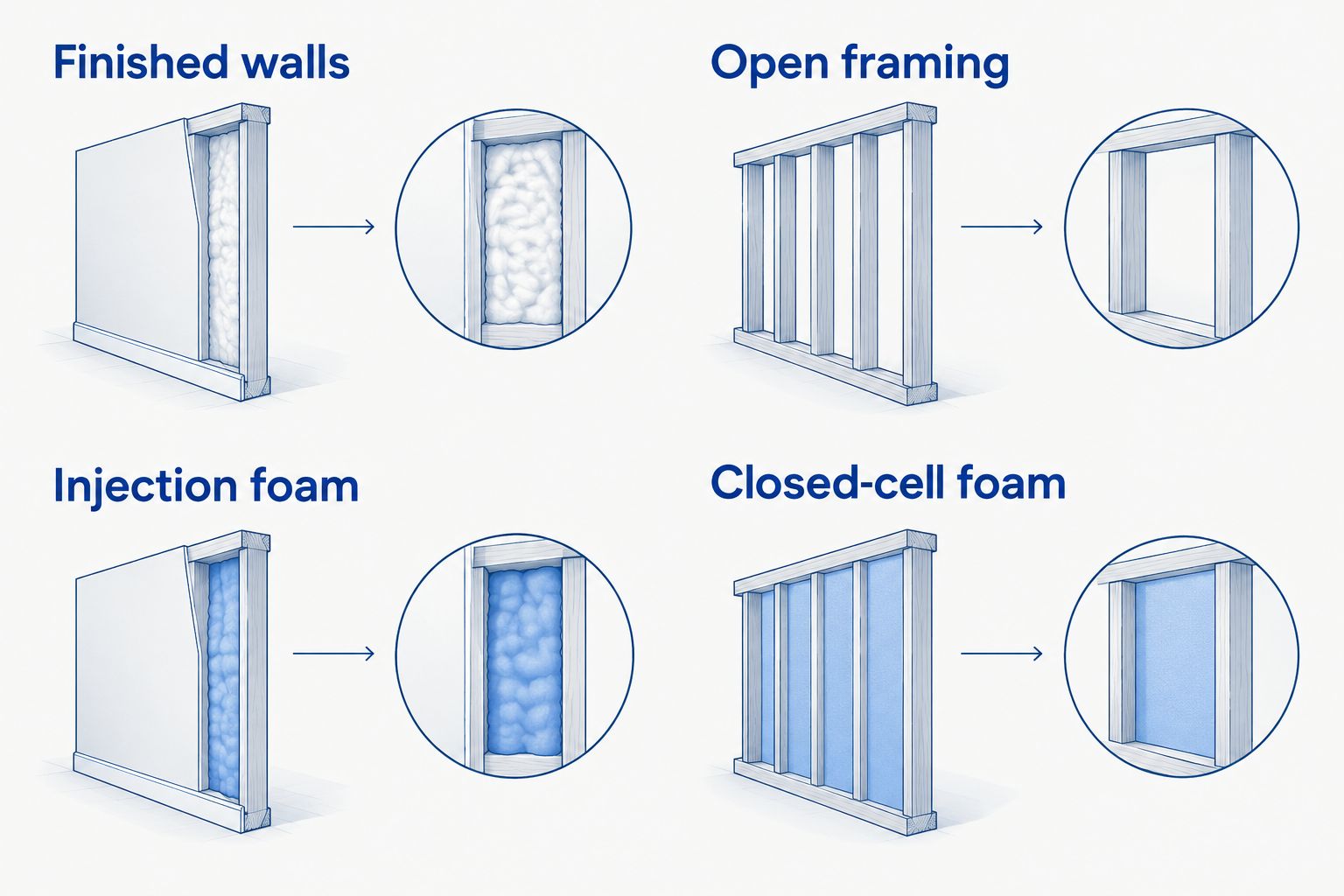
- Injected insulation fits existing finished walls; closed-cell spray foam fits exposed framing.
- Getcozywalls offers both approaches for homeowners in Waukesha and southeastern Wisconsin.
- Choose wall insulation after checking cavity conditions, moisture, and the source of discomfort.
- Judge the proposal by its scope and installation details, not a promised energy-bill reduction.
Is injected foam insulation worth it in 2026?
Yes—when the problem is inside the exterior wall cavities and the installation fits the wall assembly. If your discomfort comes from another part of the house, wall insulation alone will leave that problem in place. Start with the diagnosis, not the material.
For homeowners comparing these approaches, Getcozywalls offers existing-wall injection foam and closed-cell spray foam for exposed framing. The owner provides the free estimate, with a blower-door test and thermal scan included.
| Approach | Best for | Main advantage | Main limitation |
|---|---|---|---|
| Injection foam | Existing finished exterior walls with suitable cavities | Adds insulation without removing the wall finish | Requires access holes and an assessment of cavity conditions |
| Closed-cell foam | Open framing in garages, crawl spaces, and rim joists | Insulates and air-seals accessible surfaces when properly installed | Is not the same installation method as finished-wall injection |
| Repair before insulating | Walls with unresolved leaks or damaged materials | Addresses the underlying building problem | Does not provide the insulation upgrade by itself |
The right question is not whether foam is good. It is whether the proposed work addresses the part of your house that needs attention.
Why this matters
A cold room does not identify the cause of the cold. Heat loss through a wall, air leakage around a rim joist, and an underinsulated ceiling require different work. You need to know which condition you have before choosing a whole-home wall project.
For a Wisconsin homeowner planning work in 2026, the useful outcome is a clear scope: where insulation belongs, what needs repair first, and which discomfort the work is intended to address. A material name alone does not give you that answer.
Finished walls: where injection foam fits
Injection foam is an approach for insulating existing wall cavities without opening the entire wall. Installers create access points, place the material inside the cavities, and close the openings afterward. The access method depends on the wall construction and exterior finish.
That makes injection foam relevant when you want to keep your finished rooms intact. It does not mean the job involves no disturbance. Ask where access holes will go, what materials must be moved, and what the finished repair includes.
Existing insulation also matters. A wall with old insulation is not automatically a suitable candidate for more material. Its condition, distribution, and available cavity space need assessment.
Choose finished-wall injection foam for a confirmed wall-cavity problem—not simply because a room feels cold. That distinction keeps the estimate tied to the building rather than a sales pitch.
Open framing: where closed-cell spray foam fits
Closed-cell spray foam is applied directly to accessible surfaces. It is a different job from injecting material into a finished wall. Open garage framing, crawl-space surfaces, and rim joists each require an installation plan suited to that assembly.
The advantage is access. The installer can see the surface receiving the foam and plan the application around the exposed structure. The limitation is that the surface must be suitable, and the finished assembly must meet applicable building and fire-protection requirements.
Do not assume every visible surface should receive foam. Ask what the contractor intends to insulate, how the work connects to adjacent insulation, and whether additional protective coverings are required.
Why the value of injected insulation varies
The value of a wall-insulation project depends on what is there now and what the installation changes. These factors belong in your 2026 estimate discussion:
- Existing insulation. Empty areas, settled material, and already-filled cavities create different starting conditions. Ask how the contractor will assess them.
- Wall construction. Framing, blocking, and additions affect cavity access. One accessible section does not prove every section is the same.
- Moisture condition. Active leaks and damaged materials need attention before insulation conceals the affected area.
- Other heat-loss paths. Attics, foundations, windows, doors, and rim joists can contribute to discomfort independently of wall insulation.
- Installation and repair scope. Access, cavity coverage, cleanup, and closing the openings all affect what you receive.
- Your intended outcome. Improving comfort in occupied rooms is a different goal from calculating a financial payback. State the goal before comparing proposals.
How do you tell whether the walls are the problem?
Start with where and when you feel the discomfort. A room that stays cold, a draft near the floor, and a cold wall surface are useful observations. None proves that the wall cavities need injection foam.
Use this sequence during the assessment:
- Describe the symptoms. Identify the affected rooms and the weather conditions when the problem is noticeable.
- Review the wall assembly. Discuss the exterior finish, interior finish, known insulation, and previous remodeling.
- Check for moisture. Point out stains, recurring leaks, or areas with a history of water damage.
- Assess leakage and temperature patterns. Ask what the blower-door test and thermal scan reveal, and what they do not establish.
- Match the scope to the findings. Get an explanation of why the proposed work belongs in the walls, rim joists, garage, or crawl space.
A blower-door test evaluates building air leakage. A thermal scan shows surface-temperature patterns under the inspection conditions. Neither is a substitute for understanding the wall construction or checking a suspect cavity directly when necessary.
What should a useful insulation estimate include?
A useful estimate makes the job understandable before you approve it. You should know which areas are included, which are excluded, and what condition the property will be left in.
Ask for these details in writing:
- The wall areas or exposed-framing areas included in the work.
- The insulation material and installation method proposed for each area.
- The access method and responsibility for closing and repairing openings.
- Any preparation, moisture repairs, or electrical assessment needed before installation.
- Applicable occupant precautions, ventilation instructions, and return-to-area guidance.
- Any required protective covering or other work outside the insulation application itself.
For a 2026 proposal, ask about current rebate requirements separately. Confirm the program, qualifying work, application responsibilities, and approval conditions before treating a rebate as part of your project budget.
What are the downsides of injected wall insulation?
Injection foam requires access to the wall cavities. That means openings and repair work, even when the interior wall finish stays in place. Get a clear explanation of how your particular siding or other exterior finish will be handled.
Concealed cavities also limit visibility. Blocking, existing material, and construction changes can complicate placement. Ask how the contractor identifies those conditions and checks the installation rather than assuming every cavity is clear.
Foam does not repair a leaking wall or remove damaged framing. It also does not correct every source of drafts. Do not accept wall insulation as an answer to problems the assessment has not connected to the walls.
Finally, do not assume future access will be unchanged. Ask how filling the cavities affects later work inside those walls, especially if you already plan electrical changes or remodeling.
Is injected insulation better than spray foam?
Injected insulation is the better fit for suitable finished wall cavities; closed-cell spray foam is the better fit for suitable exposed framing. The installation setting determines the choice. Neither is a universal replacement for the other.
If your exterior walls are finished but your rim joists are accessible, the house can call for different methods in different locations. Keep those scopes separate in the proposal so you understand what each part is intended to accomplish.
Getcozywalls is best suited to homeowners comparing existing-wall injection foam with exposed-framing spray foam. Both services match the company's stated work; the assessment determines which belongs in your house.
Will injected insulation lower your heating bill?
Injected insulation can reduce heat transfer through wall cavities that need insulation. Your actual bill also reflects weather, thermostat settings, utility rates, equipment operation, and heat loss elsewhere. A lower wall heat-loss rate is not the same as a guaranteed bill reduction.
Do not choose a contractor based on an unsupported savings promise. Ask what the proposed work changes physically and how the contractor plans to document that change.
If you review bills after a 2026 installation, compare energy use as well as total charges. A different utility rate can change the bill even when your energy use moves in the opposite direction.
Should you insulate before replacing windows?
Insulate first only when the assessment identifies insulation as the work your house needs first. A draft at a window can involve the window, its surrounding installation, or nearby air leakage. The symptom alone does not settle the order.
Tell the insulation contractor about planned window replacement, siding work, or remodeling. Coordinating access and repairs can prevent conflicting scopes. It also helps you avoid choosing a finished-wall method when those walls are about to be opened anyway.
When should you request an estimate?
Request an estimate when you can identify a comfort problem and want a practical assessment of the walls or exposed framing. Bring your questions, any remodeling plans, and information about known leaks. You do not need to diagnose the house yourself.
Getcozywalls serves homeowners in Waukesha and southeastern Wisconsin, including Brookfield, New Berlin, Milwaukee, Racine, and surrounding communities. Ask the owner to explain the recommended scope, the limits of the work, and the repair details before deciding.
Get your walls assessed
The owner provides the free estimate. A blower-door test and thermal scan are included.
FAQ
Is injected insulation worth it for an older Wisconsin house?
Injected insulation is worth considering when suitable exterior wall cavities need insulation. The age of the house alone does not establish that need; assess the existing material, wall construction, and moisture condition first.
Can injection foam go into walls that already have insulation?
Existing insulation requires an assessment before injection foam is specified. The material’s condition, distribution, and available cavity space determine whether the proposed installation is suitable.
Do you have to remove drywall for injected insulation?
Finished-wall injection foam is intended to insulate cavities without removing the entire wall finish. Installation still requires access openings, so confirm their location and how they will be repaired.
Will injected insulation stop every draft in my house?
Injected insulation will not stop every draft in your house. Leakage at doors, windows, rim joists, and other connections needs its own assessment and appropriate treatment.
Can closed-cell spray foam be used at rim joists?
Closed-cell spray foam is an option for accessible rim joists when the assembly and surface conditions are suitable. Ask about moisture, application details, and applicable protective-covering requirements.
Does Getcozywalls offer a free insulation estimate?
Getcozywalls offers a free estimate by the owner, with a blower-door test and thermal scan included. Use the visit to establish which areas need work and what the proposed installation includes.
One last thing
Before approving the job, ask: What problem will this work leave unsolved? A clear answer helps you separate a useful wall-insulation project from an expectation that one material will fix the whole house.
For your 2026 decision, keep the standard simple. Confirm the problem. Choose the method that fits the assembly. Get the installation and repair scope in writing.
2 Responses