
Yes. Rim joist insulation helps drafts when outside air is entering through gaps around the perimeter of your basement or crawl space. For a Fort Atkinson home, the job needs to address air leakage as well as heat loss; it will not fix drafts coming from windows, doors, or other untreated areas.
- Rim joist insulation helps when drafts come from gaps at the floor framing above the foundation.
- Closed-cell spray foam suits exposed rim joists; injection foam serves existing finished-wall cavities.
- Find leaks and moisture problems before covering the framing.
- Getcozywalls offers rim joist spray foam services for homeowners in Fort Atkinson and southeastern Wisconsin.
Why this matters
A cold floor does not tell you where the problem starts. Air entering at the basement perimeter can affect the rooms above, but a cold room can also have a separate wall, window, or garage-related problem.
Your next step is to identify the leak, not choose foam thickness from a picture. For a 2026 project, request an insulation estimate that separates the rim joist work from any other recommended insulation. You should understand what each part of the job is meant to fix.
Can rim joist insulation help drafts in Fort Atkinson homes?
Rim joist insulation helps drafts when the rim joist area is an air-leakage path. The rim joist closes the ends of the floor framing around the outside edge of a house. In an unfinished basement, you can often find it above the foundation wall, between the floor joists.
That perimeter contains joints between framing members and connections near the foundation. Gaps at those connections let air move. Insulation that covers the wood but leaves those gaps open does not solve the same problem as air sealing.
Use this inspection sequence before deciding on the work:
- Locate the exposed perimeter. Identify the rim joists above the foundation and note where ceilings or finishes hide them.
- Check the condition. Look for water staining, damp wood, deterioration, or other conditions that need attention before insulation.
- Find the leakage paths. Check framing connections and penetrations rather than assuming every cold surface is an air leak.
- Define the treatment. Specify which accessible areas need air sealing and insulation, and identify any areas excluded from the job.
- Plan verification. Ask how the contractor will check the completed work and explain any remaining leakage.
The distinction matters: a cool surface is evidence of a temperature difference, not proof of an open gap. Treat the actual leakage path instead of covering the nearest visible surface.
Rim joists, finished walls, and garages need different work
Closed-cell spray foam and injection foam are not interchangeable job descriptions. The right approach depends on whether the framing is exposed and which part of the house needs treatment.
| Area | Best for | What the work addresses | Main limitation |
|---|---|---|---|
| Rim joists | Accessible framing above a basement or crawl space foundation | Heat loss and air leakage at the treated perimeter | Does not address leaks elsewhere in the house |
| Finished walls | Existing exterior wall cavities behind finished surfaces | Wall-cavity insulation through an injection approach | Does not replace a separate rim joist inspection |
| Garage framing | Exposed garage walls or other accessible framing | Insulation and air sealing within the specified garage assembly | Does not resolve every cause of a cold room above a garage |
For accessible rim joists, closed-cell spray foam can provide insulation and an air barrier when installed as a continuous, properly detailed application. Its usefulness depends on preparation, coverage, and the condition of the surfaces underneath it.
Injection foam serves a different purpose: insulating existing exterior wall cavities without treating them as open framing. If your concern extends beyond the basement perimeter, read whether injected foam insulation is worth it before combining wall work with a rim joist project.
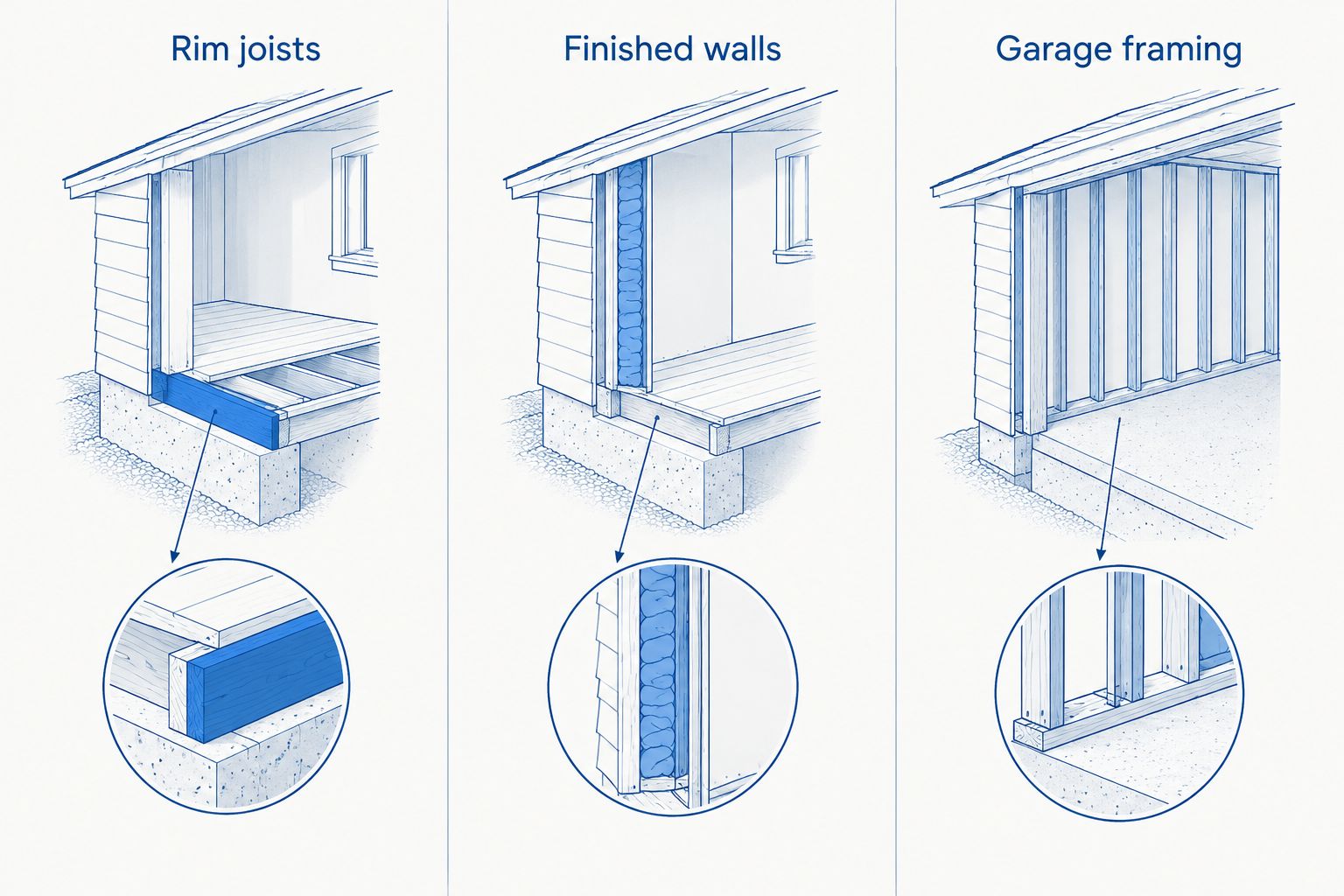
A combined estimate can make sense when more than one area needs attention. Keep the scopes separate anyway. You should be able to tell which work addresses the basement draft and which work addresses another comfort problem.
What rim joist insulation does—and does not—fix
A properly detailed rim joist application addresses the treated framing and its air-leakage connections. That is the benefit. It is also the boundary of the job.
If outside air enters around the basement perimeter, closing those paths removes that source of drafts. Insulating the same area also reduces heat transfer through the treated assembly. Neither result means the entire house becomes airtight.
Do not treat rim joist insulation as a whole-house draft guarantee. A leaky exterior door, an untreated wall cavity, or a separate attic air leak remains a separate issue. The estimate should explain those limits before installation, not after you notice another cold spot.
There are practical trade-offs, too:
- Access matters. Finished ceilings or other obstructions can prevent treatment of the full perimeter.
- The wood gets covered. Inspect its condition before foam makes parts of the surface harder to examine.
- Connections matter. Missed edges and penetrations leave gaps in an otherwise insulated area.
- Safety details remain. Foam near ignition sources and any required protective covering need a code-compliant plan.
Ask the contractor to identify these conditions in your house. A clear limitation is more useful than a promise that one treatment fixes every draft.
Why rim joist results vary
The same service name can describe different amounts of work. For a Fort Atkinson homeowner comparing 2026 estimates, these factors explain why scope matters more than a broad promise of comfort.
- Leak location. Rim joist work addresses rim joist leakage. It does not move a window or door leak into the treatment area.
- Accessible perimeter. Open framing allows direct inspection and application. Hidden sections need a separate access discussion.
- Existing materials. Old insulation can obscure the wood and framing connections that need inspection.
- Moisture condition. Wet or damaged materials require a repair plan before covering them.
- Application continuity. Insulating the middle of a cavity is not enough if air can still pass around its edges.
- Other untreated areas. Comfort depends on the rest of the room and house as well as the rim joists.
These are inspection questions, not reasons to assume your home needs more work. Start with the source of the draft. Add another area to the scope only when there is a clear reason.
How do you tell whether the draft starts at the rim joist?
Look for the connection between the complaint upstairs and the accessible framing below. Describe exactly where you feel moving air, when you notice it, and whether nearby rooms have the same problem.
An inspection should consider the rim joists alongside nearby windows, doors, and penetrations. Feeling cold near a basement wall is not enough to identify the source. Air can travel from an opening before you notice it somewhere else.
Bring those observations to your 2026 estimate. A useful description is specific: the floor feels cold along an outside wall, or moving air is noticeable near the basement perimeter. That gives the inspection a starting point without deciding the answer in advance.
Can you spray foam over old rim joist insulation?
Do not assume old insulation should stay in place. The contractor needs access to inspect the underlying framing and prepare the surfaces that will receive foam.
Fibrous insulation and an air barrier do different jobs. Material tucked between joists does not, by itself, establish that the perimeter connections are sealed. The estimate should say what will be removed, what will remain, and how concealed conditions will be handled.
Avoid disturbing unidentified materials yourself. If the existing material or its condition raises a safety concern, resolve that before opening up the work area.
Will rim joist insulation fix a cold room above the garage?
Rim joist insulation will not necessarily fix a cold room above a garage. That room can involve a different floor assembly, garage framing, and air-leakage connections.
Have the room and the garage evaluated as a connected problem. Treating the basement perimeter does not substitute for inspecting the boundary between an attached garage and the living space above it.
The useful question is not whether spray foam belongs somewhere in the house. It is which assembly separates the cold space from the room you want to improve.
What should your estimate include?
Getcozywalls is a fit for Fort Atkinson homeowners seeking closed-cell spray foam for exposed rim joists. The company also offers injection foam for existing exterior walls, but those are separate applications with separate purposes.
The owner provides the free estimate. Blower-door testing and a thermal scan are included in the service offering, but they answer different questions and should not be described as the same test.
A blower-door test evaluates air leakage by creating a pressure difference across the house. A thermal scan shows surface-temperature patterns. Getcozywalls uses thermal scanning for drywall applications and spray foam work, including rim joists; a thermal camera does not see through walls.
For your 2026 estimate, ask for a written scope covering:
- Treatment boundaries. Which rim joist sections are included, and which are inaccessible?
- Preparation. What existing insulation or obstructions need removal?
- Condition checks. What happens if the inspection exposes damp or deteriorated wood?
- Application details. How will the framing connections and penetrations be addressed?
- Safety requirements. What protective covering, ventilation, and re-entry instructions apply to the installation?
- Completion checks. How will the treated area be checked, and what will the testing explain?
The limitation is straightforward: a rim joist service covers the agreed rim joist scope. Ask for separate recommendations if the inspection identifies another source of drafts. Do not let several unrelated problems disappear into one vague line item.
FAQ
Will rim joist insulation stop all the drafts in my house?
Rim joist insulation will not stop all house drafts. It addresses the treated perimeter; windows, doors, wall cavities, and other leakage paths need their own evaluation.
Is closed-cell spray foam the same as injection foam?
Closed-cell spray foam is not the same application as injection foam. Closed-cell spray foam serves exposed framing such as rim joists, while injection foam serves existing exterior wall cavities.
Should wet rim joists be insulated right away?
Wet rim joists need a moisture investigation before insulation. Find and correct the source, then address the condition of the wood before covering it.
Can a thermal scan see through my basement walls?
A thermal scan cannot see through walls. It shows surface-temperature patterns and does not replace a physical inspection or blower-door testing.
Does Getcozywalls serve homeowners in Fort Atkinson?
Getcozywalls serves homeowners in Fort Atkinson and southeastern Wisconsin. The service offering includes closed-cell spray foam for accessible rim joists and other exposed framing.
What should I ask before scheduling rim joist insulation in 2026?
Ask for the treatment boundaries, preparation requirements, moisture findings, safety instructions, and completion checks. Keep any finished-wall or garage work separate in the written scope.
Do I need to remove my basement ceiling for rim joist insulation?
Ceiling removal is not an automatic requirement for every rim joist job. The contractor must inspect access and explain whether finished areas prevent treatment of any perimeter sections.
One last thing
Ask to see the areas that will remain untreated. That question often tells you more about the scope than a description of the foam itself.
For a 2026 rim joist project, the useful before-and-after comparison is not just bare wood versus foam. It is an identified leakage path, a defined treatment, and a clear explanation of anything left outside the job.