
Ask spray foam contractors what they will insulate, why the material suits that part of your home, and how they will handle preparation, ventilation, and final inspection. Get the scope, exclusions, and re-entry instructions in writing before you agree to the work. For Oak Creek homeowners, the first distinction is finished-wall injection foam versus closed-cell spray foam for exposed framing—not which contractor gives the shortest sales pitch.
- Ask spray foam contractors to separate finished-wall injection foam from closed-cell spray foam for exposed framing.
- Cozy Walls fits homeowners seeking an owner-led estimate for wall insulation, garage insulation, crawl spaces, or rim joists.
- Require written preparation, ventilation, re-entry, and inspection instructions before installation.
- Compare the same surfaces and exclusions, not just the total estimate.
Why this matters
A garage wall, a crawl space, and an enclosed exterior wall are different jobs. Calling all of them foam insulation hides the details you need to compare contractors. Your estimate should name the assembly, the material, and the work needed to install it.
Cozy Walls serves Oak Creek within its Southern Wisconsin service area. The owner provides the free estimate. Cozy Walls is best for homeowners who want an owner-led estimate for existing-wall injection foam or exposed-framing spray foam. Start with the problem you feel, then ask which part of the house needs attention.
What should Oak Creek homeowners ask spray foam contractors?
Use these questions during your 2026 estimate. Ask each contractor the same questions, and keep the written answers with the proposal. A verbal promise is difficult to compare with a detailed scope.
1. What surfaces are you proposing to insulate?
Ask the contractor to point out the exact boundaries of the job. In a garage, does the proposal cover walls, the ceiling, or both? In a crawl space, which surfaces are included, and where does the proposed insulation stop?
Have the contractor mark exclusions as clearly as included work. A proposal for garage walls does not answer a complaint about a cold room above the garage unless the contractor explains that connection. The scope should follow the comfort problem, not just the easiest surface to reach.
2. Why does this material fit this assembly?
Ask whether the work involves finished cavities or exposed framing. Injection foam for existing exterior walls is a different service from closed-cell spray foam applied to accessible framing. The contractor should explain that distinction without treating the materials as interchangeable.
Ask what access the installation requires and what remains afterward. That includes openings, repairs, protection, and cleanup. Do not assume those tasks are included because the proposal says insulation.
3. What must be fixed before installation?
Ask about visible moisture, damaged materials, access restrictions, and anything that needs another trade. Get a clear answer about who handles each issue. Insulation should not become a cover for an unresolved building problem.
If the contractor identifies a prerequisite, put it in the schedule. Ask what condition must be met before the crew starts and how it will be checked. That avoids an argument after the work area is already cleared.
4. How will you protect the house and its occupants?
Ask for the installation-day plan, including work-area isolation, ventilation, and access restrictions. Request product-specific instructions for when occupants and pets can return. Do not substitute a generic waiting period for the instructions that apply to the actual installation.
Ask how the crew will protect stored belongings, adjacent finishes, and equipment. You also need to know which areas must be empty before arrival. Get those instructions early enough to prepare without rushing.
5. What will the finished work look like?
Ask how the contractor determines the required application and checks the completed work. Request an explanation of coverage, transitions, and any areas that will remain accessible for inspection. The answer should describe the assembly, not just the appearance of the foam.
Ask whether the proposed installation needs a protective covering under applicable requirements and who supplies it. Foam installation and a finished, usable room are not automatically the same scope. The written estimate should make that boundary clear.
6. What happens if the inspection finds a problem?
Ask who conducts the final walkthrough and how concerns are documented. Find out how missed areas, cleanup issues, or differences from the agreed scope are handled. Have the contractor explain any written warranty rather than assuming one exists.
Keep the proposal, product information, installation instructions, and completion records together. You should be able to identify what was installed and where without relying on memory. That matters long after the crew leaves.
Which insulation belongs in each part of the house?
Choose the installation method around access and the building assembly. Finished exterior walls and open framing need separate conversations. For a 2026 project, ask the estimator to label each proposed method rather than using foam as a catch-all term.
| Method | Best for | Main advantage | Limitation to discuss |
|---|---|---|---|
| Injection foam | Existing exterior wall cavities | Addresses enclosed walls without treating the project as open-framing spray work | Access, cavity conditions, and repairs need a defined plan |
| Closed-cell foam | Exposed framing in garages, crawl spaces, and rim joists | Applies insulation directly to accessible surfaces | Requires preparation, installation controls, and assembly-specific finishing decisions |
The table is a starting point, not an installation specification. Ask the contractor to explain why the selected approach fits your actual walls or framing. A material name alone does not establish a complete scope.
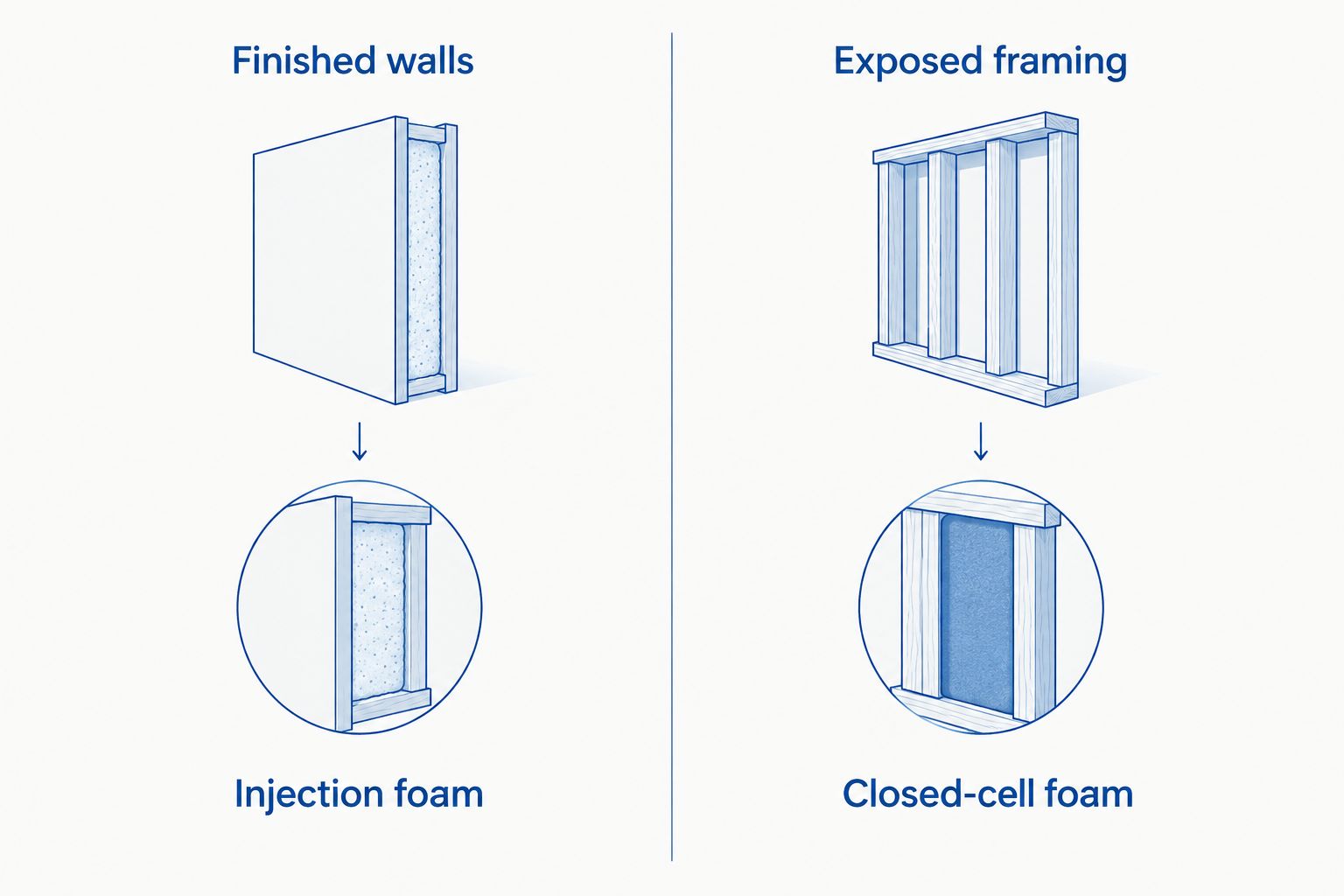
Existing exterior walls: ask about access and repairs
For finished walls, ask how the installer assesses the cavities and reaches them. Discuss the wall finish before agreeing to inspection methods. Drywall, plaster, and masonry should not receive the same explanation by default.
For brick homes, injection foam installation takes 2–3 days depending on size. Do not carry a siding-home timeline into a brick estimate. Ask how the contractor will handle access and the visible repairs associated with your exterior.
Garages: ask where the insulated boundary belongs
Tell the estimator how you use the garage and which space feels uncomfortable. A workshop, an unconditioned storage area, and a garage beneath a living space raise different scope questions. Ask the contractor to explain the proposed boundary before discussing the application.
Closed-cell spray foam is an option for exposed garage framing. Its limitation is access: a finished garage requires a discussion about what must be opened or addressed differently. Do not assume the garage ceiling is included in a wall-insulation proposal.
Crawl spaces and rim joists: ask what needs attention first
Ask the contractor to identify moisture concerns, access obstacles, and the surfaces included in the work. At rim joists, request a clear description of the transitions and areas being sealed. A broad promise to stop drafts is not a substitute for that description.
For crawl spaces, ask what preparation belongs to you and what belongs to the crew. Storage removal and access arrangements should be settled before installation day. Any work outside the insulation scope needs a named next step.
Why spray foam proposals vary
Different totals often reflect different work. Compare these scope drivers before deciding that one contractor is more expensive for the same job.
- Included surfaces. Garage walls, garage ceilings, crawl-space surfaces, and rim joists are separate areas. Confirm which ones appear in each proposal.
- Access and preparation. Finished surfaces, stored belongings, and restricted work areas change the preparation plan. Ask who handles each task.
- Existing conditions. Moisture concerns and damaged materials require an explicit response. The proposal should identify prerequisites rather than bury them in assumptions.
- Installation and protection. Ask what ventilation, isolation, surface protection, and cleanup the contractor includes. Compare written provisions, not general assurances.
- Finishing and verification. Protective coverings, repairs, testing, and the final walkthrough need clear responsibility. Identify exclusions before comparing totals.
For a 2026 estimate, use one written scope as your comparison sheet. If another contractor proposes a different approach, ask why. A different scope deserves an explanation—not an automatic rejection or acceptance.
What should a contractor inspect before recommending foam?
The inspection should connect your complaint to the proposed work. Show the estimator where you feel drafts, which rooms are uncomfortable, and whether the problem changes with the season. Then ask what observations support the recommendation.
The guide to what Milwaukee spray foam contractors inspect first covers a closely related question for nearby homeowners. Use the inspection discussion to distinguish a targeted recommendation from a proposal that simply covers every accessible surface.
What does a thermal scan actually tell me?
A thermal scan shows surface-temperature patterns. It does not see through walls. Cozy Walls includes a thermal scan and blower-door testing; its thermal-scan service applies to drywall applications and spray foam jobs, including rim joists.
Do not accept a claim that a scan works through brick, plaster, concrete block, or cinder block. Ask what surface is being examined and what the findings establish. A scan should support an explanation, not replace it.
Is blower-door testing the same as a thermal scan?
Blower-door testing evaluates building air leakage under controlled pressure. A thermal scan examines surface-temperature patterns. They serve different purposes, so ask the contractor to explain each result separately.
Ask how the findings affect your proposed scope. A test result is useful when it helps identify the work or assess the outcome. It is not a reason to skip the explanation of what will actually be insulated.
How do I compare contractors without choosing on price alone?
Build a short comparison sheet for your 2026 project. Include the surfaces, material, preparation, occupant instructions, finishing responsibilities, and completion checks. Leave space beside every item for exclusions.
Then ask each contractor to resolve unclear language. Terms such as complete coverage or whole garage need boundaries. The strongest proposal is the one you can explain back in plain language without filling gaps yourself.
Before signing, request current insurance documentation and clarify who will perform the work. Ask about any permits or inspections applicable to the proposed assembly. Do not assume that another contractor's answer covers this contractor's responsibilities.
Choose a defined job, not a vague promise of a warmer house. You need to know what happens before installation, during application, and at handover. That is a sound basis for requesting a qualified estimate.
Get your insulation scope checked
Request a free owner-led estimate for your Oak Creek home’s walls, garage, crawl space, or rim joists.
FAQ
What should I ask spray foam contractors before hiring one?
Ask spray foam contractors to define the surfaces, material, preparation, ventilation, re-entry instructions, and completion checks in writing. Compare those details before comparing the proposal totals.
Can spray foam contractors insulate walls without removing drywall?
Finished-wall injection foam is a separate service from closed-cell spray foam for exposed framing. Ask the contractor which method fits your wall cavities and what access and repairs are required.
How long does injection foam installation take in a brick home?
Brick-home injection foam installation takes 2–3 days depending on size. Ask for a schedule based on your home’s construction rather than a general siding-home timeline.
Can a thermal scan see through my brick walls?
A thermal scan does not see through brick walls. Cozy Walls describes its thermal-scan service for drywall applications and spray foam jobs, including rim joists—not as a way to see through masonry or plaster.
How long do I need to stay out after spray foam installation?
Follow the product-specific re-entry instructions provided for your installation. Request those instructions before scheduling so you can plan for occupants and pets.
Should I insulate garage walls or the ceiling under a cold bedroom?
Ask the contractor to inspect the assembly separating the garage from the cold bedroom before selecting the scope. Garage wall insulation alone does not define the work needed at that separation.
Does an Oak Creek insulation estimate include testing?
Cozy Walls includes blower-door testing and a thermal scan with its service. Ask other contractors to identify their included checks, and keep air-leakage testing distinct from surface-temperature scanning.
One last thing
Before accepting a 2026 proposal, ask the contractor to show you where the insulation stops. That question exposes unclear scope quickly. It also gives you a practical checklist for the final walkthrough: the agreed surfaces, the transitions, the exclusions, and the finished condition.