
Before crawl space spray foam insulation in Whitewater, fix active water entry, plumbing leaks, damaged framing, and any existing mold problem. The surfaces receiving foam must meet the foam manufacturer's preparation and moisture requirements. Decide how the crawl space will handle ground moisture, ventilation, and combustion safety before covering anything.
- Crawl space spray foam insulation belongs after water, framing, and mold repairs—not over unresolved damage.
- Choose the insulation boundary before deciding which crawl space surfaces receive foam.
- Getcozywalls offers closed-cell spray foam for homeowners in Whitewater and southeastern Wisconsin.
- Keep drainage, inspection access, and combustion safety in the installation plan.
What must be fixed before crawl space foam in Whitewater?
Fix the cause of wet or damaged conditions before insulating the crawl space. Foam is not a substitute for drainage repairs, sound framing, or mold cleanup. For your 2026 project, use this order:
- Water entry: Identify roof runoff, foundation seepage, groundwater, and plumbing leaks. Complete the repairs needed to stop active wetting.
- Damaged materials: Have deteriorated framing assessed. Complete necessary structural repairs before insulation hides the surface.
- Existing mold: Address the moisture source and determine the cleanup work required before covering affected materials.
- Ground moisture: Decide how exposed earth, drainage, and any ground vapor barrier fit into the crawl space plan.
- Safety and access: Resolve unsafe wiring, combustion-air conflicts, and access problems before installation.
- Surface preparation: Remove unsuitable material and confirm that the substrate meets the selected foam's installation requirements.
Getcozywalls is a fit for Whitewater homeowners seeking closed-cell crawl space spray foam insulation. The service addresses insulation; drainage, structural repairs, and remediation need their own clearly defined scope.
Why this matters
An insulation job covers surfaces you currently can inspect. Once foam conceals a joint, a stain, or damaged wood, finding the original problem becomes harder.
That changes the order of work. Document questionable areas first. Repair them next. Insulate only after the condition is suitable for the proposed assembly.
For a Whitewater home, a cold floor alone does not tell you where foam belongs. Air leakage, missing insulation, ground moisture, and water entry are different problems. Your estimate should distinguish them instead of treating every symptom as an insulation problem.
Stop water before preparing the foam surface
Start with the water you can see. Look for standing water, wet soil, dripping pipes, stains beneath plumbing, and dampness along the foundation. Note whether the condition follows rain, snowmelt, or fixture use.
Check outside, too. Disconnected downspouts and soil sloping toward the foundation deserve attention before interior insulation. A contractor needs that history even when the crawl space happens to look dry during the visit.
Do not use a dry inspection day as proof that a recurring leak is fixed. Explain when the space gets wet and show photographs from those conditions. That gives the people planning repairs a clearer starting point.
Keep these jobs separate:
- Drainage repairs address the route water takes toward or into the crawl space.
- Plumbing repairs stop leaks from supply, drain, or other water-carrying lines.
- Ground vapor control limits moisture movement from exposed earth into the space.
- Spray foam insulation controls heat flow and, when installed as part of a continuous assembly, air leakage.
A 2026 insulation proposal should identify unresolved moisture work, not assume another contractor will handle it.
Repair framing before foam hides it
Soft wood, sagging members, damaged connections, and evidence of insect activity need assessment before insulation. A surface stain is not enough to establish whether framing is sound. Neither is a photograph taken from the access opening.
Have the questionable area examined by the appropriate professional. If structural work is required, finish it while the framing remains accessible. Keep records showing what was repaired and where.
Old insulation also needs a decision. Wet, contaminated, loose, or obstructive material can interfere with inspection and installation. Ask what must come out, who removes it, and how the remaining surfaces will be prepared.
Do not ask an insulation crew to make damaged framing disappear under foam. Covering the evidence does not repair the wood. It also leaves the next person with less information.
Choose the insulation boundary before choosing the coverage
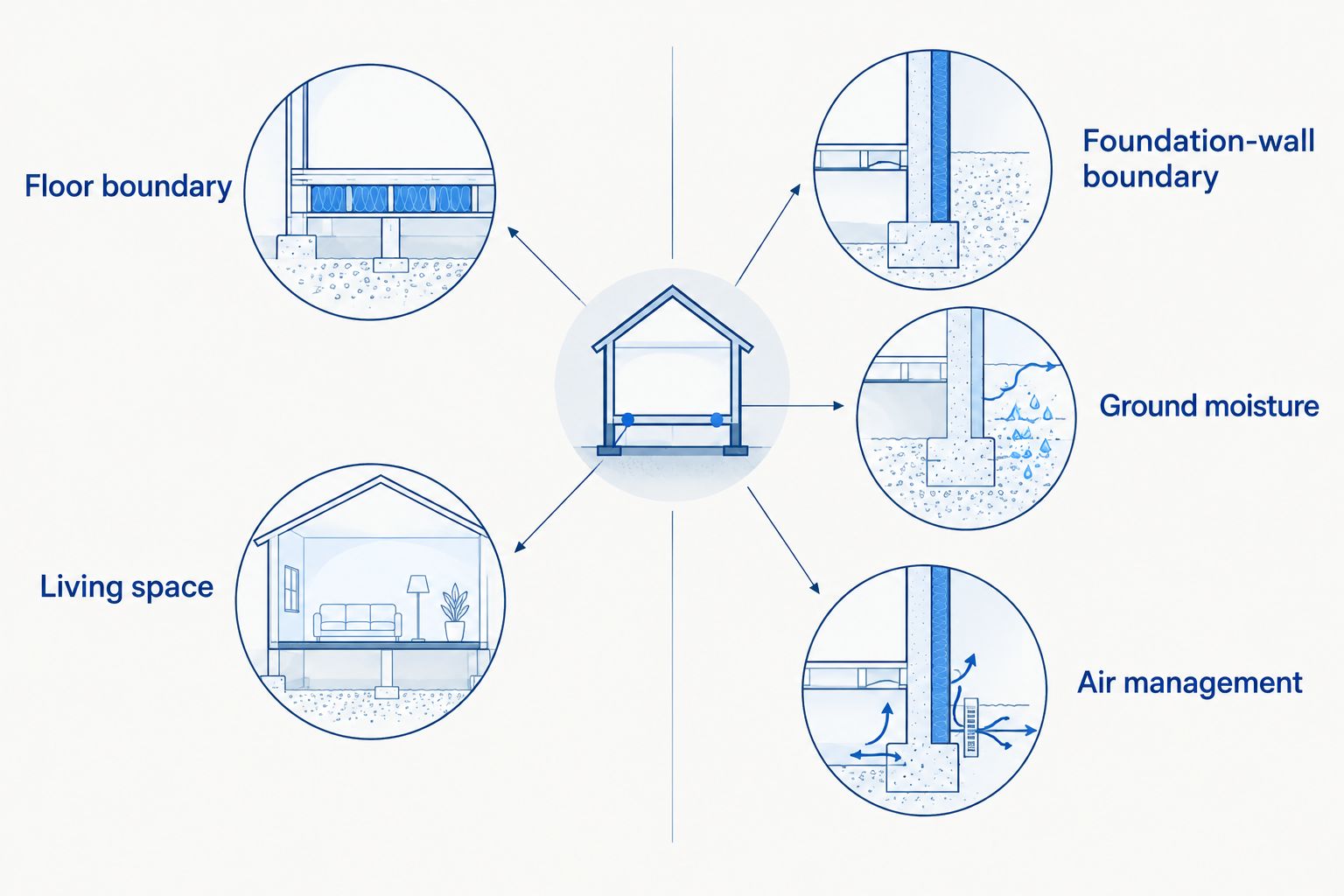
A crawl space plan needs a clear answer to a basic question: Is the crawl space outside the home's insulated enclosure, or will it become part of that enclosure? That decision changes which surfaces need treatment and how moisture and air are managed.
Neither approach excuses unresolved water or safety problems. Compare the proposed assemblies before comparing how much foam each includes.
| Approach | Best for | Main benefit | Limitation to resolve |
|---|---|---|---|
| Floor boundary | A plan that keeps the crawl space outside the insulated enclosure | Places the insulation boundary beneath the living space | Crawl space pipes and equipment remain outside that boundary; air sealing needs careful detailing |
| Foundation-wall boundary | A plan that brings the crawl space inside the insulated enclosure | Moves the insulation boundary to the perimeter | Requires a coordinated ground-moisture, air-management, and ventilation plan |
The table describes assembly choices, not permission to spray every available surface. Local requirements, existing equipment, access, and the selected foam system affect the final design.
Ask the estimator to trace the proposed boundary around the entire space. Where does it cross the rim joist? What happens at the access hatch? How will penetrations and transitions be handled? Gaps between separate scopes are easy to miss.
Keep equipment safe and repairs accessible
Before your 2026 installation, identify everything that shares the crawl space with the insulation. That includes wiring, plumbing, ducts, drains, combustion equipment, and service openings.
Air sealing changes how air moves through a house. If fuel-burning equipment relies on air from the crawl space, have a qualified professional evaluate the proposed changes. Do not block an opening simply because cold air comes through it.
Check required clearances around heat-producing equipment and venting. The installer must follow the foam product's instructions and applicable requirements, including any required protective covering. Do not assume exposed foam is acceptable everywhere.
Keep serviceable components reachable. Valves, cleanouts, electrical junction boxes, equipment panels, and inspection areas should not disappear behind insulation. Agree on access details before installation, when changes are simpler.
Ask for the product-specific instructions covering occupant precautions, ventilation, and re-entry. Use the instructions for the actual foam being installed, not a generic waiting period from another job.
Why crawl space preparation varies
Preparation depends on the condition of your house, not just the floor area. These factors change the work that must happen before foam:
- Water history: Recurring seepage needs a different investigation from a repaired plumbing leak.
- Framing condition: Sound, accessible wood requires less repair planning than deteriorated or concealed framing.
- Existing materials: Old insulation and debris can block inspection or prevent proper surface preparation.
- Ground conditions: Exposed earth and an existing ground vapor barrier need different assessments.
- Equipment and access: Combustion appliances, crowded utilities, and restricted entry affect safe installation.
- Enclosure design: A floor-boundary plan and a foundation-wall plan have different transitions and moisture-control details.
These differences explain why a phone description cannot settle the entire scope. An estimate needs to connect the observed conditions to the proposed assembly.
Can crawl space foam cover an existing mold problem?
No. Spray foam is not a mold-cleanup method. Resolve the moisture source and determine the necessary remediation before covering affected surfaces. That remains the order of work in 2026.
The central issue in addressing existing crawl space mold is separating moisture prevention from cleanup: changing the enclosure does not remove contamination already present. Encapsulation and insulation can form part of a moisture-control plan, but neither establishes that affected materials are ready to cover.
A musty smell deserves investigation, not a diagnosis from the access hatch. Ask which materials are affected, what work is required, and how readiness for insulation will be determined. Keep the cleanup scope distinct from the foam scope.
After cleanup, do not skip the water question. If the condition that caused wetting remains, insulation does not make that condition acceptable. Confirm both the repair and the surface preparation before installation starts.
What should you prepare before the estimate?
You do not need to diagnose the crawl space yourself. You do need to give the estimator a clear picture of the symptoms and safe access to the area.
Gather 4 photo groups if you can do so safely: the access opening, visible water or stains, existing insulation, and equipment or utility lines. Do not enter an unsafe crawl space to collect them. Photos support the visit; they do not replace inspection.
Write down when the problem shows up. Cold floors during wind, dampness after rain, and a leak during fixture use point to different investigations. Include any prior drainage, plumbing, mold, or framing work.
Getcozywalls provides a free estimate by the owner, with blower-door testing and a thermal scan included. Keep those 2 diagnostic tools distinct: blower-door testing evaluates building air leakage, while a thermal scan shows surface-temperature patterns. Neither establishes that hidden framing is structurally sound.
The thermal-scan service applies to drywall applications and spray foam work, including rim joists. It does not see through walls. Do not treat it as a way to inspect through brick, plaster, concrete block, or cinder block.
Bring your questions to the contact page when requesting an estimate. Describe the crawl space condition, not just the room that feels cold.
What should the written foam scope include?
A useful 2026 proposal separates prerequisite repairs from the insulation installation. It should tell you what must be ready before the crew arrives and identify work excluded from the insulation scope.
Before approving crawl space spray foam insulation, confirm these 3 decisions:
- The boundary: Which surfaces receive insulation, and how do the rim joists, penetrations, and access opening connect?
- The prerequisites: Who handles water, framing, cleanup, removal, and surface preparation?
- The safety details: What product requirements, protective coverings, equipment clearances, ventilation instructions, and access provisions apply?
Closed-cell spray foam for exposed crawl space surfaces is not the same installation as injection foam for existing finished exterior walls. Keep those scopes separate if your house needs both. A wall-insulation estimate does not automatically answer the crawl space questions.
Approve a defined assembly, not a promise to spray wherever the house feels cold. The written scope should make the limits as clear as the coverage.
FAQ
Can I insulate my crawl space before fixing a leak?
Fix an active leak before installing crawl space insulation. The installation surfaces must meet the selected foam manufacturer’s preparation and moisture requirements.
Does closed-cell spray foam replace a ground vapor barrier?
Do not assume closed-cell spray foam replaces ground vapor control. The crawl space plan must address exposed earth separately from the surfaces receiving insulation.
Should crawl space vents be closed before spray foam?
Vent treatment must follow the chosen crawl space assembly and applicable requirements. Do not close vents without resolving moisture management and any combustion-air needs.
Can spray foam go over moldy crawl space wood?
Do not cover an unresolved mold problem with spray foam. Address the moisture source, determine the cleanup required, and establish that the surface is ready for insulation.
Should spray foam go on crawl space walls or under the floor?
The enclosure design determines whether insulation belongs at the foundation walls or beneath the floor. Ask the estimator to explain the boundary and how it handles ground moisture, utilities, and transitions.
Can a thermal scan show rot behind crawl space insulation?
A thermal scan cannot establish that hidden wood is free of rot. It shows surface-temperature patterns; questionable framing requires an appropriate inspection.
Does Getcozywalls serve Whitewater homeowners?
Getcozywalls serves Whitewater homeowners with closed-cell spray foam services. The owner provides the free estimate; describe any water, framing, or mold concerns when requesting the visit.
One last thing
Photograph the repaired surfaces before they are covered. Keep those photos with the insulation scope and repair records. They preserve information about framing, penetrations, and access points that finished insulation can conceal.
For your 2026 project, the next move is straightforward: identify unresolved water and damage, then request an estimate that separates repairs from foam. Better insulation starts with a surface and an assembly ready for it.